Here's something that comes up constantly in coaching conversations: most students who eventually join physics tuition didn't decide to join because they suddenly felt motivated. They joined because something broke — a bad test, a chapter that completely lost them, a board exam that went worse than expected. The decision is almost always reactive. Students comparing options also come across physics tutor Sector 85 Gurgaon.
Which is fine. But the students who do best are usually the ones who came in before the wheels fully came off, not after. Students comparing options also come across IIT JEE coaching in Gurgaon.
If you're already searching for physics tuition classes in Gurgaon, you're probably somewhere in that zone — things aren't going badly enough to panic, but they're not going well enough to feel confident either. So let's talk about what actually matters when you're choosing where to go. Students comparing options also come across NEET coaching in Gurgaon.
Students — and honestly, some parents — tend to assume that struggling with physics means the student isn't smart enough or isn't trying hard enough. Neither of those is usually the issue.
Physics at the Class 11 and 12 level, and especially for JEE and NEET, demands something school teaching rarely builds: the ability to look at an unfamiliar situation and figure out which concept applies, then apply it correctly under time pressure. That's not a knowledge problem. It's a thinking problem. And it's built through a specific kind of practice that most students aren't doing on their own.
Rote memorisation of formulas without understanding what they represent produces students who can solve the exact problems they've seen and freeze on the ones they haven't. That's the pattern. Breaking it requires a teacher who starts with the concept before ever putting a formula on the board — and enough practice problems that the thinking eventually becomes instinct.
The institute covers the full range — Class 9 through Class 12, plus JEE and NEET preparation — but what students consistently mention isn't the breadth. It's the pace and the attention.
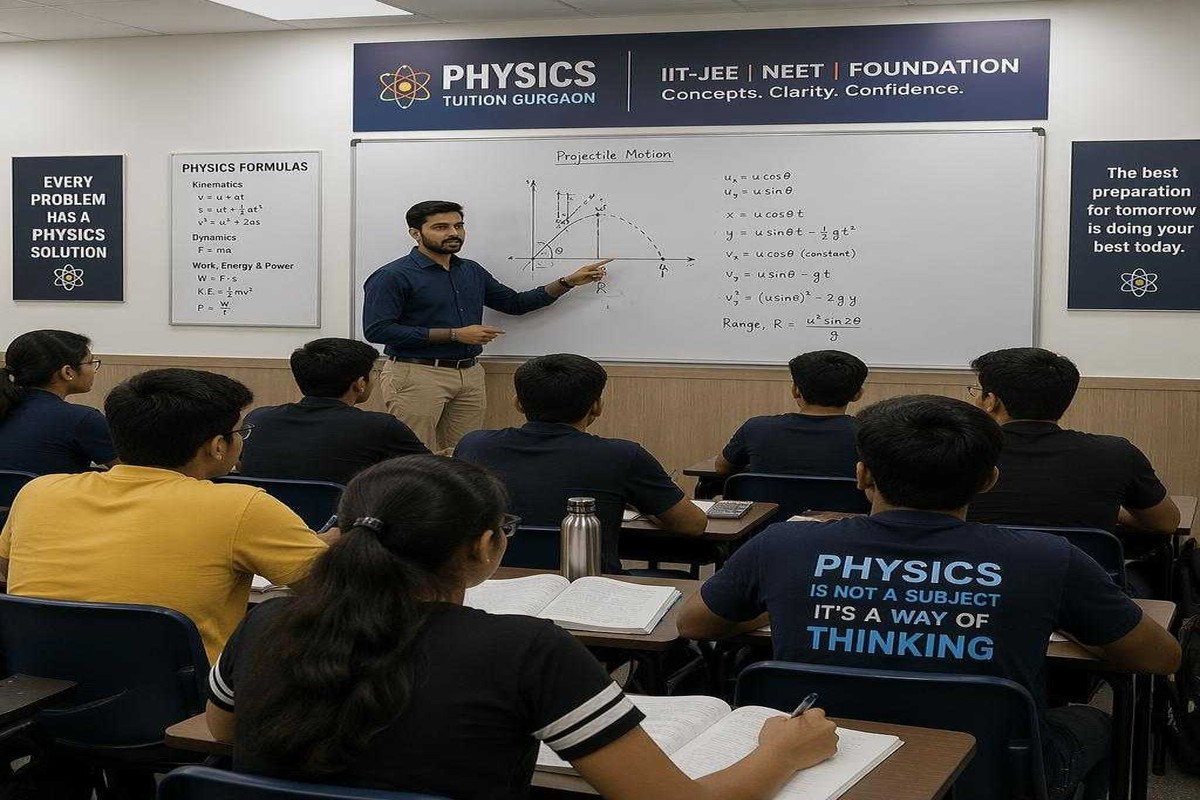
Small batches mean teachers actually know where each student is. Not in a vague general sense, but specifically — which student got projectile motion but is shaky on circular motion, which one can do the numerical but can't write the derivation cleanly. That kind of tracking is impossible in a class of 50. In a small batch, it's just what teaching looks like.
The doubt sessions here are scheduled, not improvised. There's a meaningful difference between "you can always come find me" and having a dedicated slot where students know they can bring the thing they've been confused about for three days without feeling like they're holding anyone up. Students who are shy — and a lot of Class 11 and 12 students are genuinely shy about asking questions — use those sessions in ways they'd never flag a confusion mid-lecture.
Testing happens chapter by chapter, right after each topic is done. Then cumulatively every month. Then full mocks as the exam approaches. The structure isn't arbitrary — testing shortly after learning is one of the most consistently supported methods for actually retaining content. Students who get tested weekly on fresh chapters remember those chapters months later. Students who only revise before the exam are mostly re-learning, not recalling.
Good Marks Classes covers the complete Class 9–12 CBSE and ICSE physics syllabus, plus competitive exam content for JEE and NEET. That includes Kinematics, Laws of Motion, Work-Energy, Gravitation, Fluid Mechanics, Thermodynamics, Electrostatics, Current Electricity, Magnetism, Electromagnetic Induction, Optics, Modern Physics, Semiconductors, Oscillations, and Waves.
Each topic runs concept-first, then formula application, then progressively harder numericals. The sequence matters — students who skip the conceptual stage and go straight to formula practice tend to hit a ceiling quickly.
When parents search for the best physics tutor in Gurugram, the instinct is usually to look at results boards and fee structures. Both matter, but neither tells you what the classroom actually feels like.
Before enrolling anywhere, sit in on a class. Ask the actual subject teacher — not the admission coordinator — to explain a concept you find difficult. Pay attention to whether the explanation builds understanding or just covers the content. Those are different things, and you can feel the difference in a single session.
Ask how many students are in each batch. Ask how doubt sessions work — when they happen, how long they run, whether students can revisit the same concept multiple times. Ask what happens if a student joins mid-year and has gaps in earlier chapters.
Any coaching centre worth joining will answer these questions without hesitation. The ones that deflect or pivot back to their results board are telling you something.
Good Marks Classes runs live online sessions for students who can't attend in person — interactive, not recorded, with the same doubt session access and test schedule as offline batches. For students in parts of Gurgaon or the wider NCR where local physics tuition options are thin, this is worth knowing.
Understand derivations rather than memorising them. If you can reconstruct a derivation from logical steps rather than recall it word-for-word, you'll handle the question regardless of how it's framed. If you've only memorised it, a slight variation in the question will throw you.
Solve problems every day, not in batches before tests. Physics numericals are a skill. Like any skill, they deteriorate without regular use and improve with consistent practice. Ten problems daily is more effective than seventy the night before a chapter test — and it's less miserable.
Work through previous years' CBSE and JEE papers once you've covered enough ground. You'll quickly see which topics appear constantly, which question types repeat, and which derivations CBSE considers essential. Five years of papers tells you more about exam priorities than any syllabus document.
NCERT deserves more respect than most Class 11 students give it. The board paper draws from NCERT examples and exercises repeatedly. Treating NCERT as a book to skim through once and then set aside is a consistent mistake. Read it carefully, multiple times.
If you're looking for physics tuition classes in Gurgaon for boards, JEE, or NEET, visit Good Marks Classes in person. Book a free demo class — attend an actual session, not just a centre tour — before committing. Talk to students who are currently enrolled if you get the chance.
The programme is open to students across the full range of starting points, from students who are already reasonably confident in physics and want to sharpen for competitive exams, to students who feel like the subject has never made sense to them. The teaching approach adapts to where students actually are, not where they're expected to be by this point in the year.
Visit goodmarksclasses.com or walk in to book your demo class.
Visit: https://goodmarksclasses.com/
Book a FREE demo class today and experience the Good Marks difference.