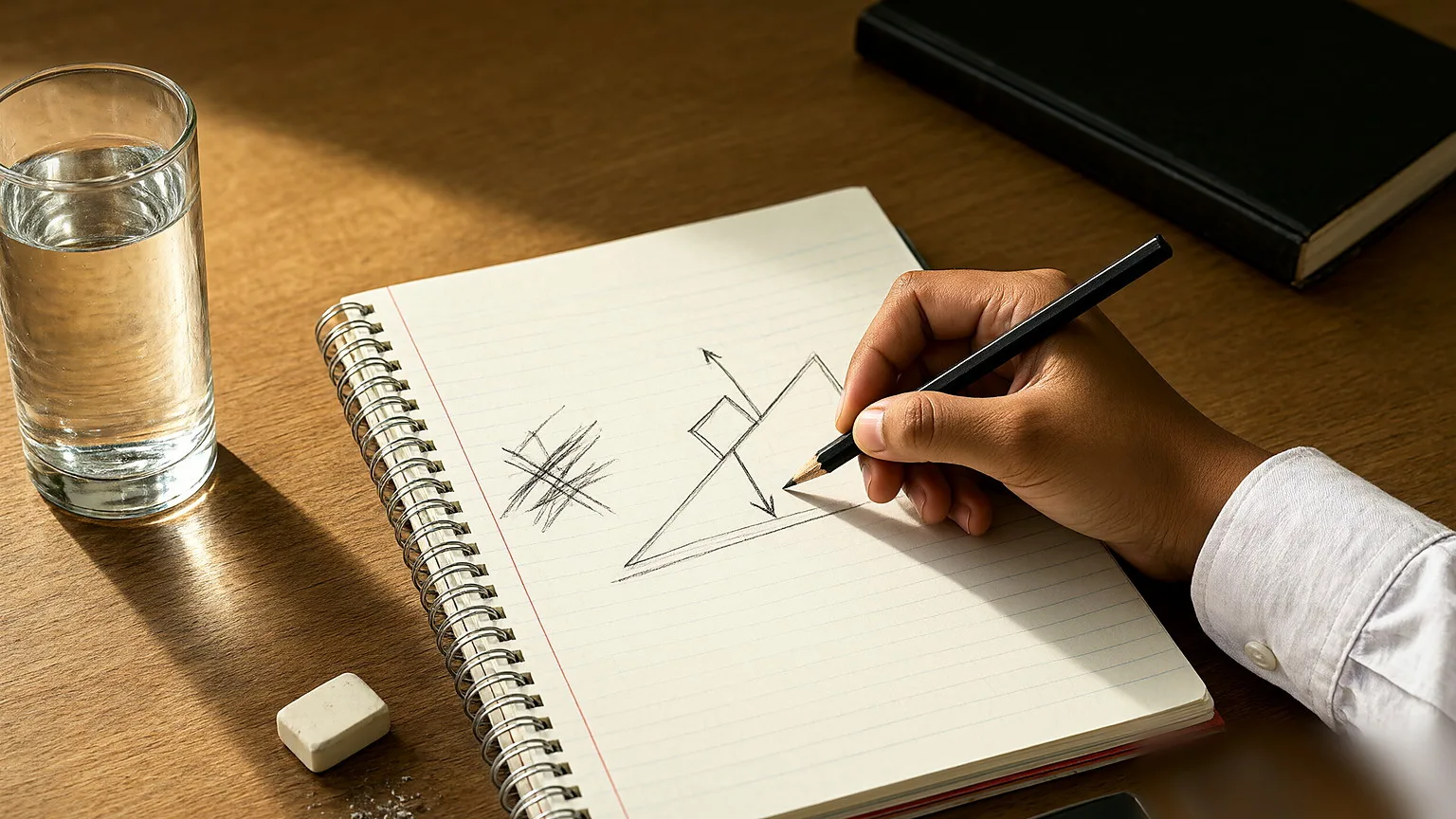
Class 11 Physics stops asking students to recall a law and starts asking them to choose one. A first-term paper in the fifties usually shows a method that broke in four specific places, not a chapter nobody read. The repair is closed-book problems and a written line on the step that failed.
Key takeaways
Class 10 Science asks a student to describe a law and substitute into a printed formula. Class 11 hands over a situation in words and asks which law applies.
| What changes | Class 10 | Class 11 |
|---|---|---|
| What earns marks | A correct value, a neat diagram. | A correct first equation, a stated assumption. |
| Where marks leak | A unit, a misread value. | A sign, a component on the wrong axis. |
The chapters arrive in order: kinematics, laws of motion, work and energy, rotation, gravitation, bulk matter, thermodynamics, kinetic theory, oscillations and waves. Each assumes the last is usable, not merely read.
The symptom. A projectile at 30° gets solved, because sin 30° and cos 30° are memorised. The same 20 m/s, given only as “an angle whose tangent is 3/4”, stops the page, though its components are friendly: 16 m/s across, 12 m/s up.
What is wrong. A vector is carried as a number with a direction note attached. In a plane it is two independent numbers that add separately: 3 N east and 4 N north give 5 N, not 7 N.
The fix. Axes and a sign convention go at the top of the page, before numbers, and a minus sign carries direction instead of a second arrow. Relative motion is the same skill in different clothes: velocity of A relative to B is vA − vB, so a boat carries two independent motions; shortest time is not shortest path.
The symptom. A two-block pulley gets one equation and a blank space. Tension is assumed equal on both sides of a pulley that has mass. Friction is written as μN whether or not the block is slipping, and its direction guessed from the push.
What is wrong. The second law is used as a formula for one object instead of one equation per body. Tension is not a property of the string; it is whatever the equations require, and on a pulley with mass the two sides differ; that difference turns it.
The fix. One free-body diagram per body, one positive direction per body, kept through the algebra. Then count. If unknowns outnumber equations, the missing piece is a constraint, not a force: one string means one speed along it, and a turning pulley adds τ = Iα.
The symptom. The three equations of motion get used where acceleration is not constant: a bead on a curved wire, a body falling with air resistance. The answer is wrong and energy gets blamed.
What is wrong. v = u + at and its companions hold only while acceleration is constant in size and direction. On a curve the direction changes every instant, so the equations fail because the condition was never stated. On a straight rough incline acceleration is constant and the equations are fine.
What “energy” hides. The work-energy theorem, net work equals change in kinetic energy, is always true. Conservation of mechanical energy holds only when nothing non-conservative does work; on a rough floor friction is the question, not a nuisance.
The fix. Energy gives a speed or a height, never a time or a direction. On a curved rough track the normal force changes, so friction's work often cannot be written down. A block sliding down a rough incline obeys mgh − W = ½mv², where W is the work done against friction. Ask for the time and energy hands back to kinematics.
The symptom. The first rotational question is left blank, or torque is taken about a point nobody chose. The list of moments of inertia gets applied about the wrong axis.
What is wrong. Moment of inertia is not a property of a body; it is a property of a body about an axis. The same disc is ½MR² about its centre and (3/2)MR² about a point on its rim.
The fix. Start with a door: push near the hinge, then at the handle. Then choose the axis and write it down before the formula list opens. τ = Iα is safe about a fixed axis, and about the centre of mass of a translating body; about any other moving point it is not.
The syllabus supplies the values of I without derivation; what is examined is the choice of axis, not the integral.
A solution on the board is a story with the hard choices already made. The sequence is supplied, so the student follows. Following feels like knowing.
It isn't. What has been built is recognition, and recognition dies in the hall, where nobody supplies the first line.
“I understood it in class” is usually honest. It's also the cheapest part: the teacher picks the principle, the student audits.
Every November: a student follows a pulley derivation at 5pm and writes the same equation for both blocks at 9am. The first line was never produced alone.
Independent practice. Book closed, blank page, one question, twenty minutes. If nothing starts in two minutes, the gap is at the start. Then one log line: which step failed.
Yes, by about a year, for half the toolkit. Physics asks for integration in kinematics, its first mechanics unit. Class 11 Maths has none: its Calculus unit is Limits and Derivatives, and integration sits in Class 12, with the chain rule.
That's sequencing, not a conspiracy, and it closes without a syllabus.
The minimum toolkit.
Thirty minutes, twice a week, three weeks. The Maths paper has its own reasons for feeling abrupt, which is why Class 11 Maths catches students off guard.
Count from Monday 2 November 2026. Six weeks ends Sunday 13 December. The dates are arithmetic, not a date sheet. Assume 45 minutes on five days.
| Week | Focus | What “done” looks like |
|---|---|---|
| 1 2–8 Nov |
Vectors | Twenty problems whose first line resolves into components. |
| 2 9–15 Nov |
Newton's laws | Fifteen problems, one diagram per body, unknowns counted first. |
| 3 16–22 Nov |
Work-energy vs kinematics | A one-page decision rule. Twelve problems. |
| 4 23–29 Nov |
Rotation and torque | Ten problems, axis written before the formula. |
| 5 30 Nov–6 Dec |
Full mechanics paper | One paper in real time, no notes, self-marked. |
| 6 7–13 Dec |
Repair | Logged questions re-solved with the book closed. |
One topic finished before the next, a log line after every session, nothing new bought in week five. If the December test lands early, merge weeks five and six.
NCERT first, for longer than feels necessary: its language is the paper's language. Cover each worked solution, attempt the next step, then uncover it. Do the exercises with the book shut. They look gentle and aren't.
One problem book, chosen once, never a third in December. A book worked twice beats three skimmed. The commercial side deserves the same scrutiny: see how to judge a Class 11 Physics batch.
Write the equation before substituting numbers. Marks are given for the equation and the substitution, not the final value alone.
Less than they think. Three that help:
Three that don't:
If you are not confident in the physics, don't re-explain it. A confident wrong explanation has to be unlearned.
Help is justified when work goes unmarked or doubts go unanswered. Low marks alone are not a reason.
Ours, for comparison. Physics is taught personally by Sunil Gola (B.Tech, DTU) for CBSE, JEE and NEET. The 2-Year JEE programme runs 900 hours across Classes 11 and 12, six classes a week. Batches cap at 10 online, 30 offline. Thursday is kept for doubts, and one-to-one sessions run online or at the Sector 85 centre.
If doubts are the problem rather than the syllabus, read how to use a doubt session. Re-explanation is not correction.
Mostly harder. Class 11 Physics asks for reasoning with vectors and forces rather than recall, so a student who memorised well in Class 10 meets a different task. Weak teaching makes it worse; good teaching alone does not fix it.
Three and a half to four hours a week on problems, separate from class and homework: 45 minutes on five days. Reading notes does not count; six hours of videos changes less than three hours of closed-book work. Log each session.
Wait if the current teacher marks scripts and clears doubts the same week. Change now if neither happens, because the gap widens through December. A switch costs two to three weeks, so mid-November is the last comfortable point. After that, add doubt help rather than replacing everything.
No. NCERT, one problem book and a teacher who marks the work can carry a student through Class 11. Coaching earns its place when doubts wait weeks, scripts come back with no comments, or nobody taught the student how to start.
Start this week and shorten week one to three days rather than skipping it. Vectors and free-body diagrams sit under everything else, so they are the wrong thing to rush. Cut problems per week before cutting weeks. Four proper weeks still move a paper.
Yes, because Class 12 Physics assumes the mechanics is usable. Circular motion returns in magnetism, work-energy in electrostatics, torque as the torque on a dipole. Repairing it now is cheaper than repairing it later, which is why Class 12 Physics does not ease you in either.
For a second opinion on the paper, book a free demo and bring the marked script. Twenty minutes with the working in front of us beats an hour on the phone. Or call 8800 8800 28.